Certified Testing
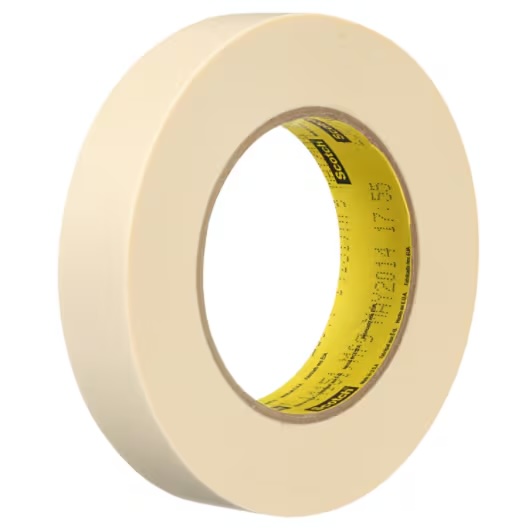
3M’s Scotch® Flatback Masking Tape 250 is designed with the user in mind. The interior of the roll features a manufacture date to ensure that you always know the shelf-life of this product. To obtain best performance use Scotch® Flatback Masking Tape 250 within 18 months from date of manufacture. Because of its unique properties Scotch® Flatback Masking Tape 250 can be certified to meet ASTM D 6123 / D 6123M-97. Scotch® Flatback Masking Tape 250 has been used to conduct testing according to ASTM D-3359; however this test method does not endorse or suggest that any particular tape must be used. Designed and manufactured for a minimum of 60 oz/inch adhesion to steel by ASTM D-3330 Method A.
From 3M's Industrial Adhesives and Tapes Division, Jan 2026:
Our supply chain has recovered from a prolonged supply disruption caused by unexpected raw material shortage. You will notice a slight difference in the color of the backing compared to the previous iteration of the 3M 250 Product. You may also observe slight variance in the tensile strength, but within the tolerances of the SAE AMS-3721standard. These differences are simply due to the raw material change affecting the paper backing.
Paint Adhesion Testing Using Pressure-Sensitive Tape
In Accordance with ASTM D3359
1. Scope and Purpose
This procedure describes the evaluation of coating adhesion using a pressure-sensitive tape method
in accordance with ASTM D3359, Standard Test Methods for Rating Adhesion by Tape Test.
A pressure-sensitive tape with sufficient adhesion strength and tensile properties shall be used
to remove coating from standardized incisions, and adhesion shall be rated based on the amount of
coating removed.
Note: ASTM D3359 does not specify a particular manufacturer or product; however,
pressure-sensitive flatback tapes such as 3M 250 with consistent adhesion and adequate tensile strength are
commonly used.
2. Selection of Test Method
ASTM D3359 provides two test methods. The appropriate method shall be selected based on coating
thickness and test environment.
2.1 Method A — X-Cut Test
- Intended for coatings greater than 5 mils (125 µm) total dry film thickness
- Commonly used for field evaluations or thick-film systems
2.2 Method B — Cross-Hatch Test
- Intended for coatings 5 mils (125 µm) or less total dry film thickness
- Typically used in laboratory or controlled shop environments
3. Test Area Preparation and Cutting
3.1 Surface Preparation
The test area shall be clean, dry, and free of oil, dust, or other contaminants that could affect
test results.
3.2 Making the Incisions
Method A (X-Cut)
- Using a sharp cutting tool, make two straight cuts approximately 40 mm (1.5 in) in length.
- The cuts shall intersect at an angle of 30° to 45°, forming an “X”.
Method B (Cross-Hatch)
Using a cross-hatch cutting tool, create a lattice pattern consisting of:
- 6 or 11 parallel cuts in each direction, as specified in ASTM D3359
- Cut spacing selected based on coating thickness per the standard
All cuts shall be made through the coating to the substrate or underlying layer, without excessive
damage to the substrate.
4. Tape Application
4.1 Tape Handling
A pressure-sensitive tape with sufficient adhesion and tensile strength shall be used.
As a best practice, the outer wraps of a new tape roll may be discarded to reduce the potential
for adhesive contamination.
4.2 Tape Placement
Cut a strip of tape of sufficient length to completely cover the test area and allow for
grasping during removal.
Apply the tape centered over the incisions.
4.3 Tape Pressing
Firmly smooth the tape over the test area using a finger.
Rub the tape with a rubber eraser or equivalent device to ensure uniform contact and
eliminate air bubbles.
4.4 Dwell Time
The tape shall remain in place and be removed within 90 seconds after application.
5. Tape Removal
- Grasp the free end of the tape and remove it rapidly in one smooth motion.
- The tape shall be pulled back upon itself at an angle as close to 180° as practicable.
- Jerking or hesitant motion shall be avoided.
6. Evaluation and Rating
Immediately after tape removal, examine the test area and the tape for coating removal.
Adhesion shall be rated in accordance with the classification scales defined in ASTM D3359:
- Method A: Ratings 0A through 5A
- Method B: Ratings 0B through 5B
The rating shall be based on the amount and pattern of coating removed, as defined by the standard.
7. Reporting
The test report shall include, at a minimum:
- Test method used (Method A or Method B)
- Adhesion rating achieved
- Description of coating system and substrate
- Tape type used
- Any deviations from ASTM D3359
This guide is for reference purposes only. Be sure to consult the ASTM standard to ensure accuracy of testing procedures.